Technology

Invisible Spectral Flicker

How EVY Light delivers 40 Hz gamma stimulation without visible flicker.

The FELIX study uses a non-invasive neurostimulation device developed by the Danish company OptoCeutics. The device — EVY Light — delivers precise 40 Hz gamma stimulation via a patented technology called Invisible Spectral Flicker (ISF).

The problem with stroboscopic flicker

Conventional luminance flicker (LF) — simple binary "on-off" pulsations of light — can entrain brainwaves at 40 Hz, but produces significant visual discomfort. Unmasked stroboscopic flicker can trigger dizziness, migraines, nausea, and in rare cases photosensitive epilepsy.

For gamma stimulation to be clinically viable as a daily home treatment, it must be tolerated over weeks without adverse effects. This requires a different strategy for entraining gamma brainwaves — one that entrains the target 40 Hz response while eliminating the perceptible flicker.
What is ISF?

Invisible Spectral Flicker is a dual-modality flicker system that combines luminance flicker with a synchronous spectral masking. The device uses two precisely calibrated colour phases — Phase 1 and Phase 2 — that alternate at 40 Hz.

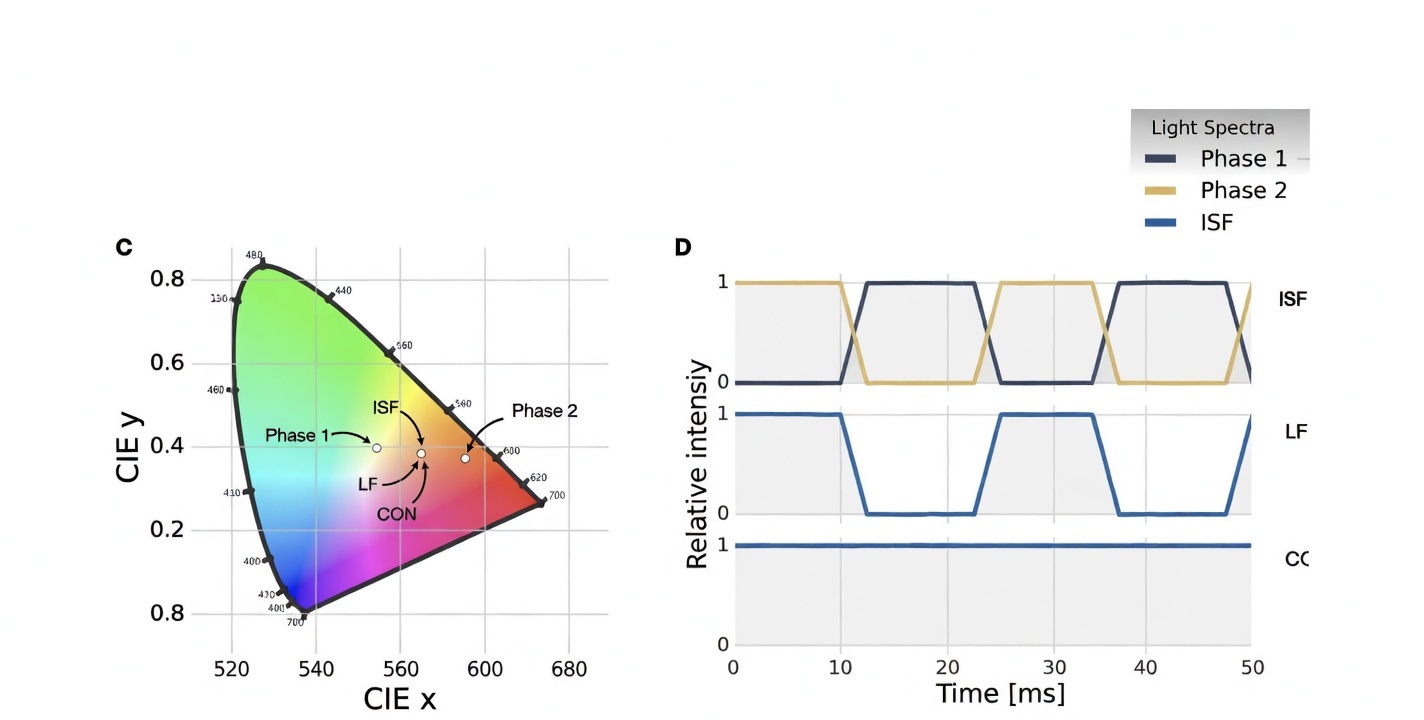
The two phases are represented as closely positioned chromaticity coordinates in the CIE 1931 colour space. They constitute two subtly differentiated spectral compositions — in practice, two nearly identical shades of white light. The phases are engineered to be metamerically matched: they appear visually identical to the human eye under typical viewing conditions, yet their spectral profiles differ sufficiently to induce the desired 40 Hz modulation.

As the light oscillates between these phases, the perceived brightness remains stable. The overt luminance change is concealed by the spectral shifts, creating an "almost imperceptible flicker effect" — while the 40 Hz rhythm penetrates the visual system and entrains neural oscillations in the brain's gamma band.

Technical diagram showing CIE 1931 chromaticity coordinates of ISF Phase 1 and Phase 2, and the corresponding relative intensity waveforms for constant colour, luminance flicker, and invisible spectral flicker over time.
Left: CIE 1931 chromaticity coordinates of Phase 1 and Phase 2, showing the closely matched colour points that produce ISF. Right: Relative intensity waveforms across three operational regimes — constant colour (CC), luminance flicker (LF), and invisible spectral flicker (ISF) — illustrating how spectral alternation masks visible pulsing while preserving the 40 Hz modulation.

Precision LED technology

The device employs high-precision LED emitters, optimised by nanotechnology specialists to ensure seamless transitions at exactly 40 cycles per second. The intensity waveform shows how the ISF trace neutralises visible pulsing while preserving the therapeutic frequency.


The EVY Light device

EVY Light is OptoCeutics' clinically tested device for daily home use. Participants in the FELIX study receive the device and use it for one hour daily over six weeks as an adjunct to their usual treatment.


Gamma entrainment: ISF vs. stroboscopic flicker

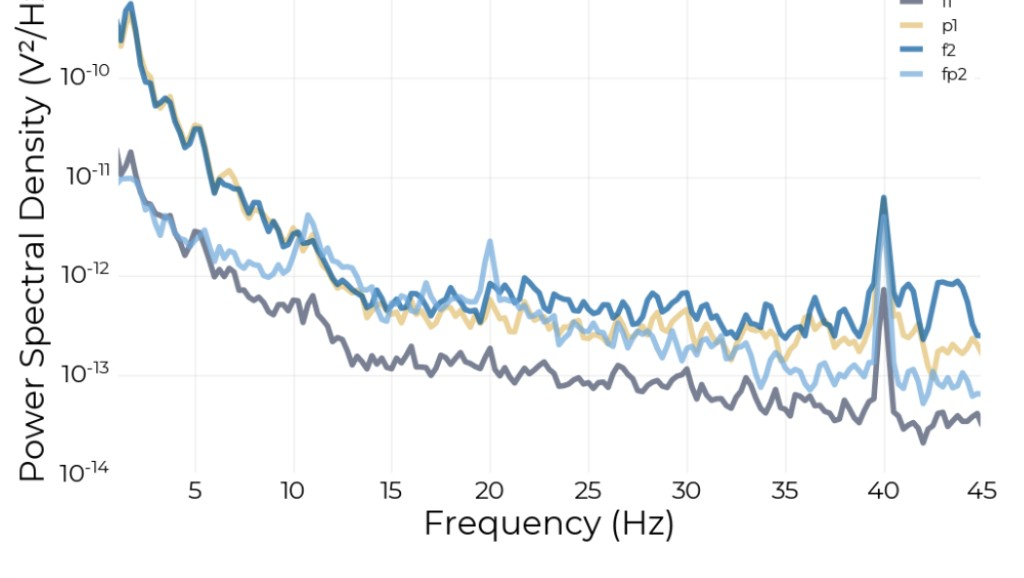
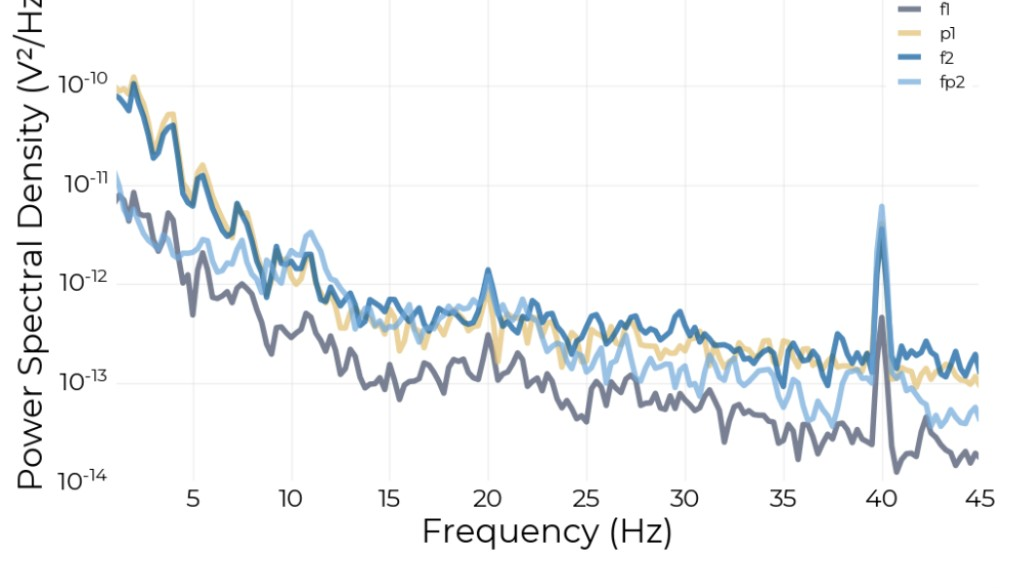
Power Spectral Density (PSD) analyses from EEG recordings demonstrate that ISF can induce gamma entrainment comparable to conventional stroboscopic flicker — but without the visible flicker and its associated adverse effects.

Power Spectral Density plot during Invisible Spectral Flicker (ISF) stimulation, showing a clear SSVEP peak at 40 Hz.
Invisible Spectral Flicker (ISF)
Power Spectral Density plot during stroboscopic flicker stimulation, showing a comparable SSVEP peak at 40 Hz.
Stroboscopic flicker (40 Hz luminance)

Both conditions show a distinct SSVEP peak at 40 Hz, demonstrating that ISF entrains gamma-band neural oscillations at a magnitude comparable to conventional stroboscopic flicker. PSD computed using Welch method, frequency range 1–45 Hz.

Read about the clinical study design.

View study design